Botanics
Blueprint Of The Wild: Why Your Houseplants Aren't Just Decorations
Now Playing
The Handsome Family - Far From the Road
Headspace
Desktop cleared, window cracked to the cold air, and that dark, dust-swept Americana rhythm pulling the noise straight out of the room. Time to step away from the screen.
As you progress in your plant journey, you realize a fundamental truth: no plant is just a plant. Every single leaf, stem, and root sitting in your home is a living archive, shaped by millions of years of combat, adaptation, and survival in a very specific corner of the planet. They are delicate, highly specialized echoes of their native environments.
When you buy your first few houseplants, it’s easy to fall into a trap: you treat them like green furniture. You pick a pot that matches your interior palette, stick the plant on a shelf, and expect it to behave like a static object that just happens to need a sip of water every Tuesday.
Then reality hits. A leaf turns yellow, a stem stretches out looking for something it can't find, or a prized collector specimen quietly collapses overnight. You start wondering what you did wrong.
The truth? You didn't necessarily fail, you just forgot to read the instruction manual.
As you progress in your plant journey, you realize a fundamental truth: no plant is just a plant. Every single leaf, stem, and root sitting in your home is a living archive, shaped by millions of years of combat, adaptation, and survival in a very specific corner of the planet. They are delicate, highly specialized echoes of their native environments.
If you want to stop guessing and start truly cultivating, you have to stop looking at your indoor jungle as a collection of décor and start looking at it as an ecosystem of geographic blueprints.
To decode how your plants want to live, we have to look at the four core territories of origin that rule the botanical world:
- 1.) The Jungle Floor (The deep, shaded understory)
- 2.) The Canopy & Climbing Zone (The high-stakes vertical ascent)
- 3.) The Arid Crucible (The desert survival zone)
- 4.) The Temperate Woodland (The resilient cool-climate zone)
Let’s strip away the nursery pots and look at how these environments forged the plants in your collection.
1. The Jungle Floor (The Understory)
- The Environment: Down at the base of a tropical rainforest, sunlight is a scarce luxury. Only 1 to 2 percent of unfiltered light punches through the multi-tiered canopy above. The air is heavy, still, and saturated with humidity, and the ground is an endless mattress of decomposing organic matter—rotting wood, fallen leaves, and rich detritus.
- The Evolutionary Strategy: These are your ultimate shade-tolerant understory dwellers. To survive, they engineer massive, broad leaves packed with high-density chlorophyll that act like high-efficiency solar panels, designed to harvest every stray photon that filters down. Because there is virtually no wind down on the floor to threaten them, they don’t need splits or holes; they maintain broad, unbroken surfaces.
- The Indoor Translation: If you blast these plants with intense, direct sun, you will literally fry their specialized light-harvesting cells. Keep them in gentle, ambient light and mirror that natural forest floor by using a loose, spongy, organic-rich soil matrix that stays damp without suffocating the roots.
Territory Spotlight: Maidenhair Fern (Adiantum)
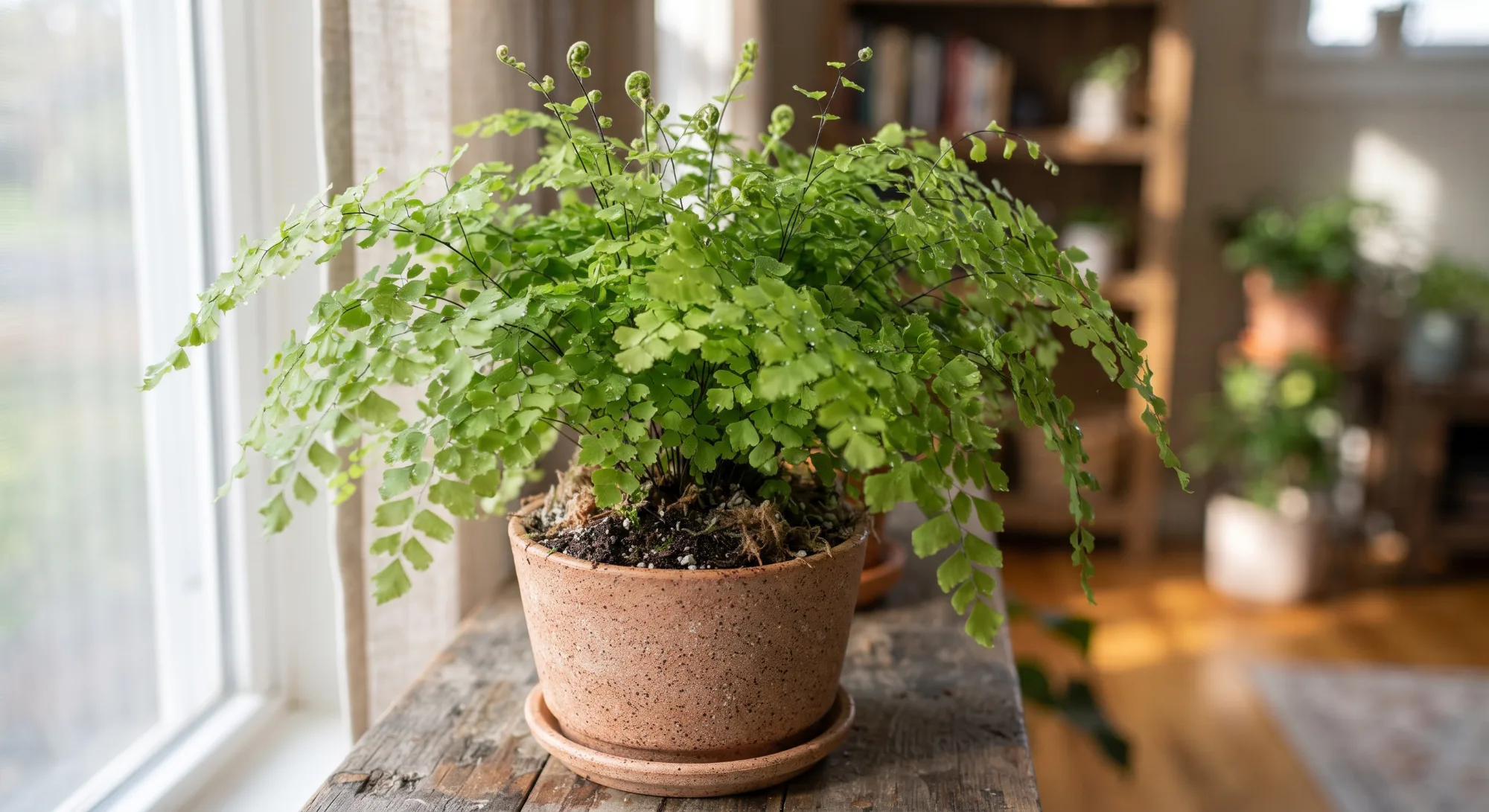
- Why it fits: Unlike epiphytic ferns that hitch a ride on bark, true terrestrial ferns like the maidenhair blanket the damp, shaded earth, rock banks, and decaying log surfaces directly on the rainforest floor.
- The environmental mirror: Its delicate, cascading fronds held by slender, wiry black stems are fine-tuned for a life completely sheltered from direct sunlight and wind. Because it lives right at ground level amid decomposing forest litter, it demands an environment that mimics that moist, highly organic understory: absolute zero direct sun (which instantly fries its delicate leaflets), high ambient humidity, and a rich, moisture-retentive substrate that never goes bone-dry.
2. The Canopy & Climbing Zone (The Ascent)
- The Environment: Moving upward from the dark forest floor, this territory is all about vertical ambition. Plants in this zone start in the gloom, lock onto a massive tree trunk using negative phototropism, and scramble aggressively upward toward the sun.
- The Evolutionary Strategy: Total structural metamorphosis. As they climb out of the dark understory into high-light zones, they undergo heteroblasty, radically reshaping their leaf architecture. In the canopy, tropical gales and violent downpours would catch a solid leaf like a sail and rip the entire vine off its host. The holes, deep lobes, or splits act as natural pressure-relief valves, letting high winds and sun flecks pass safely through. They rely on coarse, woody bark for grip and thick aerial roots for stabilization.
- The Indoor Translation: Stop treating climbers like potted bushes. Give them a sturdy cedar plank, a rough totem, or a moss pole to adhere to. Ditch dense peat for coarse, chunky bark, and position them in the brightest possible ambient light (even gentle direct sun) to trigger that magnificent mature leaf size.
Territory Spotlight: Philodendron squamiferum
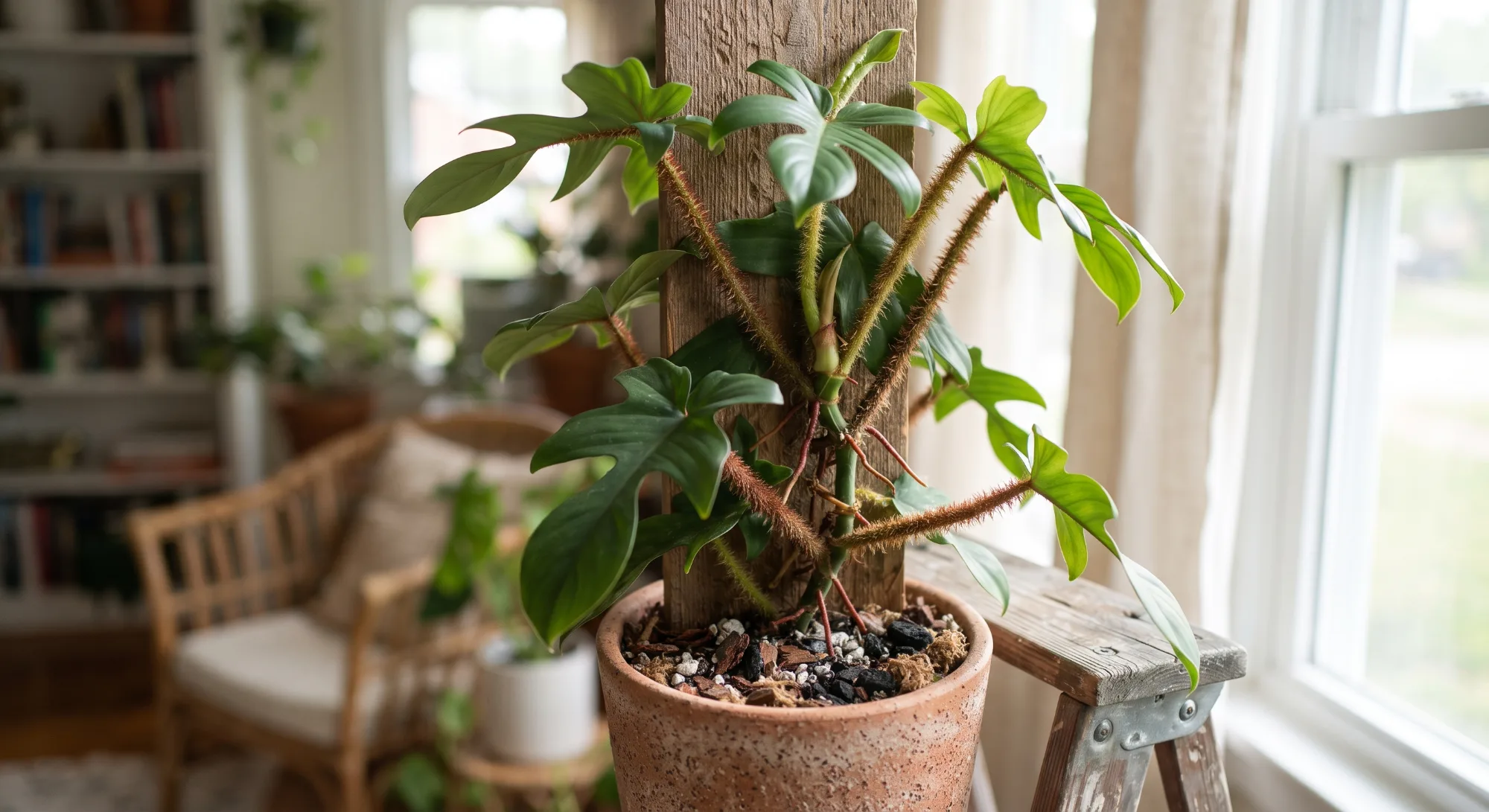
- Why it fits: This climbing epiphyte spends its juvenile life hunting for a vertical host tree in the rainforest, scaling high up into the canopy where it undergoes a dramatic leaf transformation into deeply lobed, fiddle-shaped blades.
- The environmental mirror: Philodendron squamiferum showcases a brilliant adaptation for the climb: its petioles (leaf stems) are covered in fuzzy, reddish-brown bristles and scales (squamae). In the wild, these bristly hairs act like biological Velcro, locking tightly against the rough, vertical bark of a host tree to prevent the heavy vine from sliding down during torrential tropical downpours. Paired with its aggressive aerial roots and chunky aroid soil, giving it a vertical plank allows its unique evolutionary hardware to kick into high gear.
3. The Arid Crucible (The Desert)
- The Environment: This is the domain of total solar radiation, punishing UV rays, and months, sometimes years, without a drop of rain. Water is not just scarce; it is the single determining factor of life. Diurnal temperature swings are extreme, shifting from scorching, sun-baked days to freezing cold nights.
- The Evolutionary Strategy: This is where the xerophytes live, cacti, succulents, and the masters of disguise, Lithops. To survive this crucible, they have completely abandoned broad, leafy stems, which lose too much moisture to evaporation. Instead, they convert their stems and leaves into swollen, fleshy, water-storage fortresses. Many utilize specialized metabolism (CAM photosynthesis), opening their breathing pores (stomata) only at night to suck in carbon dioxide without losing precious internal moisture to the daytime sun.
- The Indoor Translation: They do not care about your humidity meter. In fact, high humidity will rot them instantly. They demand blazing light, absolute minimum organic matter in the soil, gritty mineral-heavy substrate (pumice, grit, sand), and long, strict periods of absolute drought where the pot goes completely bone dry to mimic their dormant season.
Territory Spotlight: Lithops (Living Stones)
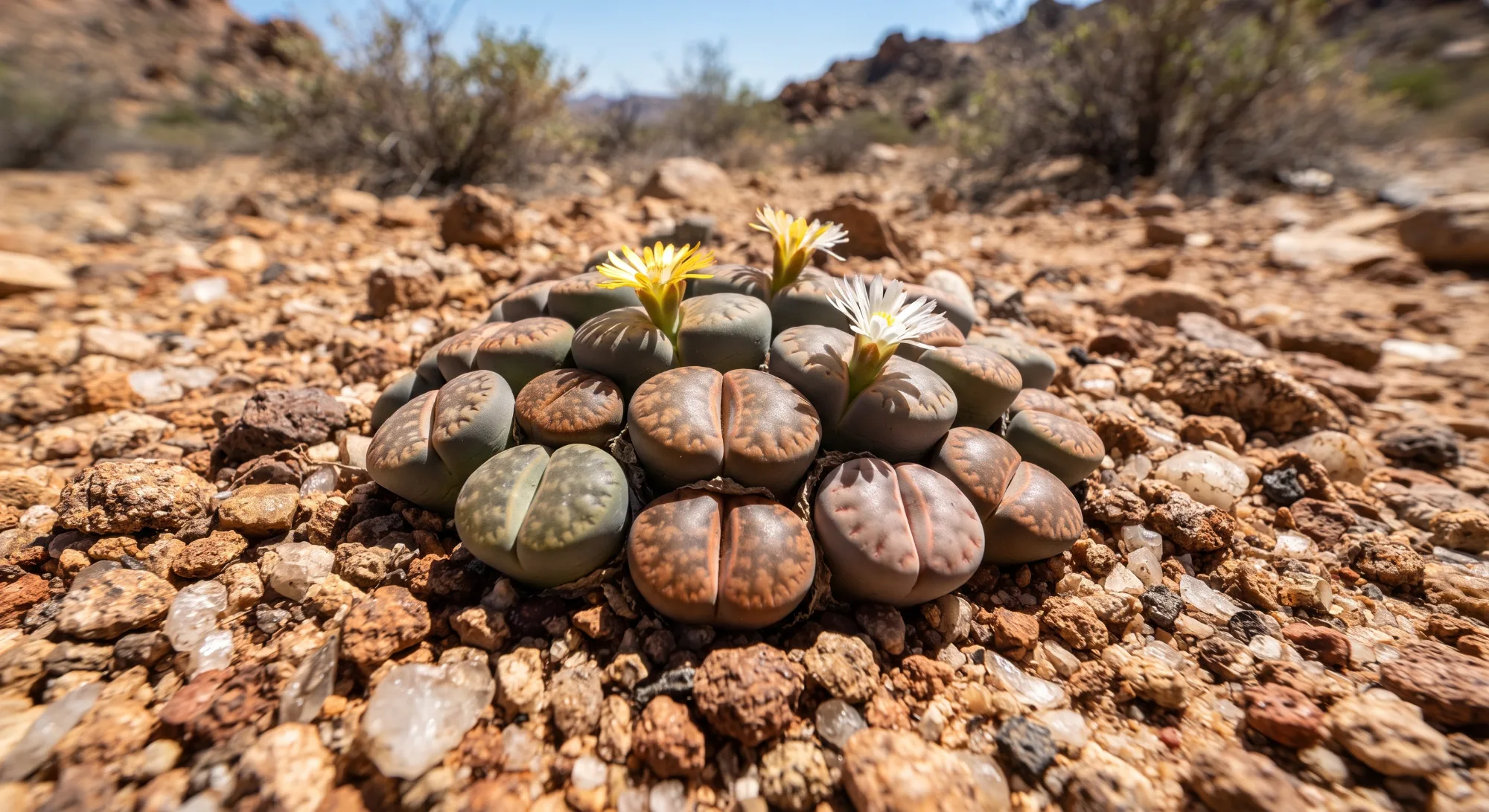
- Why it fits: Native to the rocky, sun-scorched deserts of Southern Africa, Lithops are perhaps the most extreme example of adaptation on earth. A mature plant consists of just two immensely swollen, fused succulent leaves separated only by a fissure.
- The environmental mirror: Lithops don't just tolerate the arid crucible; they use it as a survival tool. To avoid being devoured by thirsty herbivores in a barren landscape, they have evolved master-class camouflage, mimicking the size, colour, and texture of the surrounding gravel and pebbles (hence the name "Living Stones"). During severe droughts, they conserve energy by shrinking entirely below the soil line, waiting until a rare rainfall triggers an explosive, brief cycle of growth and flowering. Trying to grow them in rich potting soil with regular water is a guaranteed death sentence; they require intense sun, gritty mineral grit, and almost zero interference.
4. The Temperate Woodland & Rocky Margins (The Cool Climate)
- The Environment: Moving away from the equator into temperate zones—like the rugged, damp climates of Northern Europe and the UK—the defining rule is seasonality and resilience. Plants here face stark contrasts: dark, freezing winters where growth halts, followed by variable spring rains and shifting sunlight. On rocky woodland edges and exposed mountain banks, soil is thin and drainage is fast.
- The Evolutionary Strategy: Armor and localized storage. Rather than dying back entirely or growing massive tropical leaves, cool-climate succulents and hardy perennials like Sempervivum hunker down into tight, overlapping geometric rosettes. They store water in fleshy leaves to survive dry spells between heavy rains, while their low-slung, flat-topped profile protects them from biting winter winds and frost.
- The Indoor/Outdoor Translation: These are your ultimate outdoor survivors. They don't want coddling, high humidity, or indoor warmth; they demand maximum light, lean, gritty soil, and reliable seasonal cold hardening outdoors.
Territory Spotlight: Sempervivum
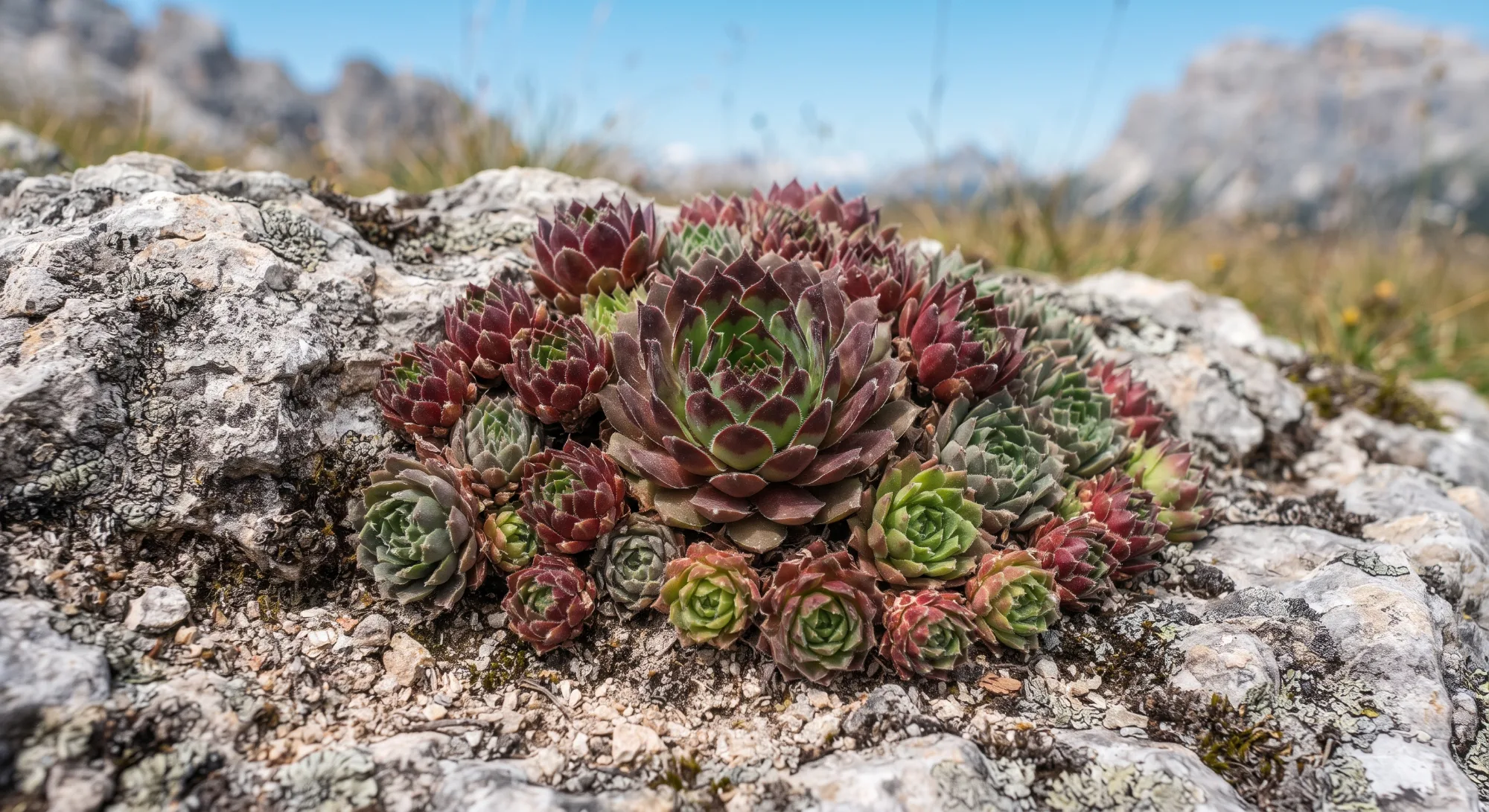
- Why it fits: Commonly known as "hens and chicks," houseleeks are native to high-altitude, rocky, and temperate environments across Europe. They thrive where soil is scarce and weather is punishing.
- The environmental mirror: Houseleeks are a masterclass in how cool-climate plants handle stress. When winter strikes and temperatures plummet below freezing, they don't perish, they draw inward, closing their rosettes tightly to protect their core growth points from frost damage. Their thick, fleshy leaves store just enough moisture to carry them through cold, dry spells, while their offsets ("chicks") crowd around the base to anchor the colony against wind and erosion. Plant them in a gritty, free-draining rockery or shallow pot outdoors, and let nature run its course.
Bridging the Gap: Hacking the Home for Wild Survivors
You now know the blueprint, but how do you take a plant fresh from a greenhouse, or worse, a big-box store, and help it thrive in the foreign environment of your living room?
It’s rarely about trying to perfectly replicate the Amazon jungle in your bedroom (good luck controlling that humidity). It’s about identifying their single biggest environmental bottleneck and giving them one specific tweak to ease the transition.
Here are the simple hacks to acclimatize your plants based on their territory, along with the golden rule for mixing them all together.
Territory 1: The Jungle Floor (The Understory)
- The Bottleneck: Light quality. Your home is likely too bright or hits them with harsh, direct sun.
- The Top Tweak: Light Filtration. Don't just move them further back from the window. Instead, diffuse the light. A sheer curtain acts as a perfect artificial canopy, scattering harsh rays into gentle, high-quality illumination that won't scorch those specialized, broad solar panels.
Territory 2: The Canopy & Climbing Zone (The Ascent)
- The Bottleneck: Vertical structure. These plants are genetically programmed to climb vertically toward the sun. Without support, they stall, stay juvenile, and often decline.
- The Top Tweak: The Moss Pole or Plank. Ditch the decorative wire hoop. Give your Monstera, Philodendron, or Epipremnum a rough cedar plank, a cork totem, or (best of all) a damp moss pole to grip. Once those aerial roots can attach to a surface, the plant receives the biological signal to mature, resulting in those magnificent, fenestrated adult leaves you bought it for.
Territory 3: The Arid Crucible (The Desert)
- The Bottleneck: Soil moisture and aeration. They hate "wet feet" more than anything else on earth.
- The Top Tweak: Radical Grittiness. Forget standard potting soil. The moment you bring a cactus, succulent, or Lithops home, repot it into a mix that is at least 50% inorganic grit (pumice, perlite, sharp sand, or crushed lava rock). This ensures lightning-fast drainage and massive aeration for roots that are designed to breathe in dry, rocky crevices.
Territory 4: The Temperate Woodland (The Cool Climate)
- The Bottleneck: Indoor warmth and stagnation. They need seasonality and fresh air.
- The Top Tweak: The Cool Window Trick. These are hardy survivors, not tropical queens. The kindest thing you can do for a houseleek (Sempervivum) indoors is to give it the coldest, brightest spot in the house, like right on a windowsill where the glass gets cold in winter, and ensure excellent airflow. They need that cool signal to enter their necessary dormant rest period.
The Golden Rule for Mixing Plants from Different Origins: Hacking the Home with Microclimates & Community
The biggest challenge isn't caring for one plant; it's caring for a collection containing all four types. You have a fern next to a cactus, under the same roof. Don’t try to average out your care. Trying to find a "happy medium" means you are actually making every plant unhappy. A compromise watering schedule will rot the cactus and dehydrate the fern.
The solution is Zonal Zoning to create beneficial microclimates. You do not need to change your home; you just need to change where and how you place things within it.
1. The Solution: Strategic Grouping. Don't disperse your collection evenly. Instead, cluster your plants together based on their specific territory blueprint. When you group several Jungle Floor plants (like ferns and Calatheas) together, they actively support each other. As they transpire (release moisture through their leaves), they raise the ambient humidity in that specific corner, creating a self-sustaining, humid cloud that benefits the entire group.
2. The Solution: The Pebble Tray for Humidity. For your humidity-loving Jungle Floor plants, you don't necessarily need a noisy, expensive electric humidifier. Instead, employ a simple, analogue hack: place the pot on a wide, shallow tray filled with decorative stones or pebbles, and add water just to the bottom of the pebbles (never let the pot sit in standing water). As the water evaporates from the large surface area of the pebbles, it creates a localized column of humid air rising directly around the plant, mimicking the damp understory without soaking the soil.
3. The Tweak: Mastering Moisture without Soil. For many climbing aroids (Territory 2) or moisture-loving epiphytes, standard, dense potting soil is often the enemy, leading to rot rather than healthy growth. To optimize moisture retention while guaranteeing aeration, advanced growers ditch soil entirely for a semi-hydroponic approach known as the "moss, perlite, and string" method. By wrapping the plant's root ball in a core of high-quality sphagnum moss (for moisture), mixing in chunky perlite (for oxygen pockets), and securing it all with string, you create a root environment that holds onto hydration in a balanced, airy fashion, preventing the dangerous anaerobic conditions of soggy soil.
By respecting their ancient blueprints and creating these supportive microclimates (and optimizing their substrate), you stop forcing your plants to adapt to you, and you start building a home where they can thrive on their own terms.