Back to Collection
Living Stones — Lithops

Living Stones

Lithops

Family · Aizoaceae

Also known as · Stone Plants

ThrivingLiving Room

My first experience with Lithops began with a small cluster of two or three specimens purchased from Highland Moss, which initially took pride of place on a living room windowsill where they could soak up the best of the day's sun. More recently, the collection has been expanded with a fresh batch acquired through an online promotion, providing a welcome second chance to work with these fascinating desert mimics.

Plant Type
Succulents
Light
Direct Sun
Water
Allow to Dry Completely
Soil Mix
Gritty / Succulent Mix
Pot Type/Size
Various
Acquired Date
2024

Personal Note

Personal note on Living Stones

In all honesty, my early journey with these living stones was a steep, sometimes humbling learning curve. Driven by inexperience and a deep-seated fear of overwatering, a single early watering triggered crown rot, while my frantic overcorrection, starving the final survivor of water to prevent rot, unfortunately led to complete dehydration. Learning hard lessons from those early losses, the new arrivals have been an absolute revelation. Planted in my own custom mineral substrate and tended to with targeted droppers and bottom watering, they have been fantastic and entirely rewarding, proving that mastering their subtle rhythms completely transforms the growing experience.

Care & Environment

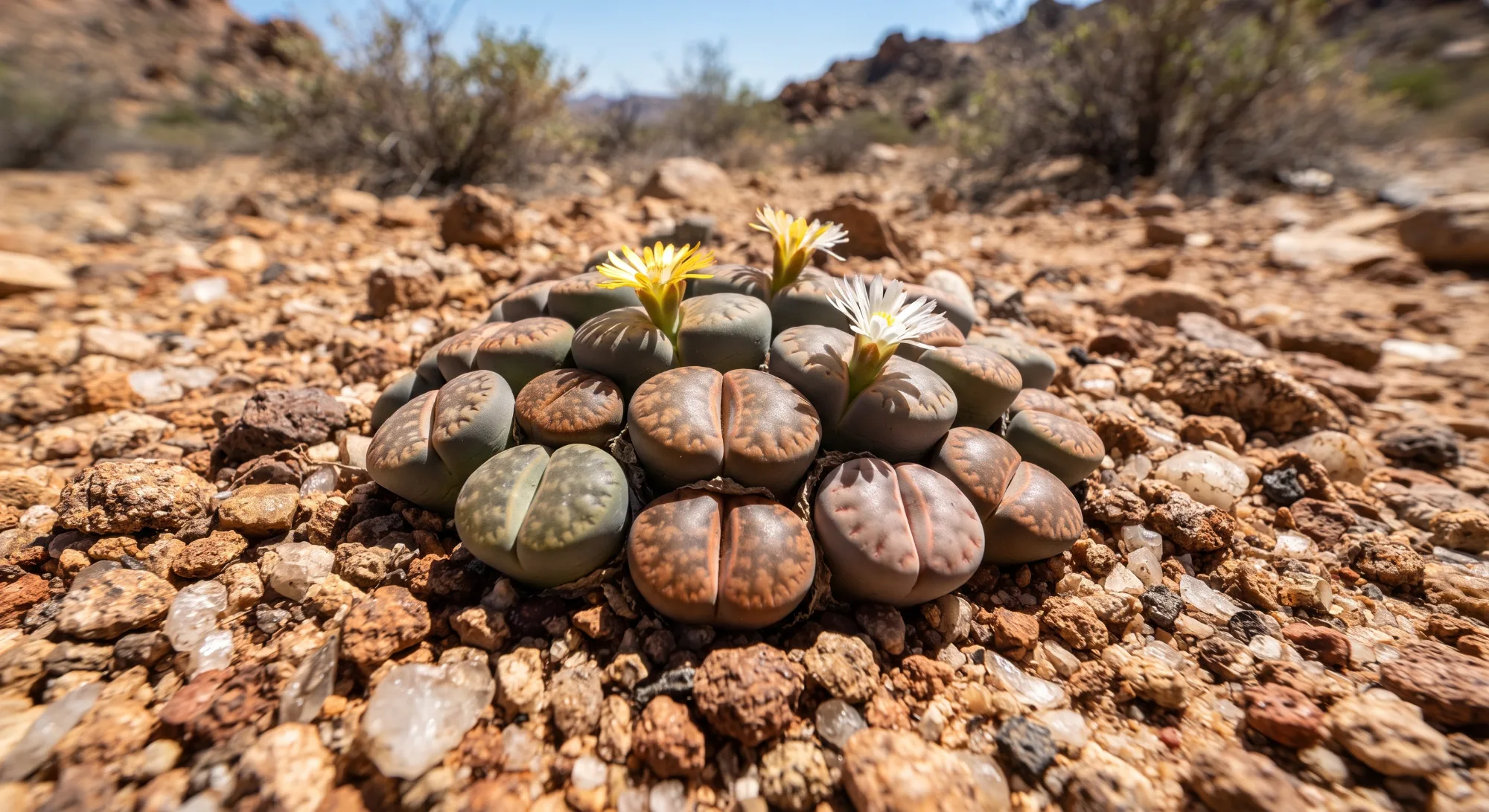
Native to the arid, sun-baked stone plains, gravel flats, and quartz fields of southern Africa, primarily across South Africa and Namibia, Lithops are masters of extreme botanical camouflage. Commonly known as living stones, these extraordinary succulents resemble split pebbles or colourful stones nestled in desert gravel. With paired, thickened leaves designed to store precious water while hiding from hungry herbivores in plain sight, they produce vibrant, daisy-like autumn flowers that emerge miraculously from the fissure between the leaves, offering an astonishing display of desert resilience.

  • Watering Routine

    Follow a strict, highly disciplined watering cycle that defies conventional houseplant care. Keep them completely dry through winter while they undergo their natural leaf-splitting cycle, water sparingly during summer only when the top surface feels slightly puckered, and never water while a new pair of leaves is actively absorbing the old ones. Overwatering or retaining moisture in winter is the single greatest hazard.

  • Soil Blend Recipe

    4 to 5 parts coarse horticultural grit, pumice, fine gravel, and perlite to 1 part low-nutrient organic cactus compost. An ultra-gritty, mineral-heavy substrate with virtually no organic matter, ensuring absolute, instantaneous drainage and replicating natural arid conditions.

  • Light & Micro-Location Details

    Thrives best in full, uncompromising direct sunlight. Ample direct sun is vital to prevent etiolation (stretching) and to preserve their compact, low-profile stone-like form. A south-facing windowsill or an exceptionally bright, unobstructed spot is essential. Insufficient light will cause them to lose their camouflage patterns and weaken structurally.

  • Dimensions & Potting Specs

    Grows extremely slowly as tiny, solitary or clump-forming miniature plants, typically staying under 3 to 5 cm in height. Prefers a deep, narrow pot (often a specialist succulent pot) that accommodates their long taproot and promotes rapid evaporation around the base.

Growth Timeline & Milestones

  1. 2024

    The Lithops join the collection.

Swipe through the log →

From the Journal

Journal Entries Featuring This Plant

  • Blueprint Of The Wild: Why Your Houseplants Aren't Just Decorations
    14th November 202610 min read

    Blueprint Of The Wild: Why Your Houseplants Aren't Just Decorations

    As you progress in your plant journey, you realize a fundamental truth: no plant is just a plant. Every single leaf, stem, and root sitting in your home is a living archive, shaped by millions of years of combat, adaptation, and survival in a very specific corner of the planet. They are delicate, highly specialized echoes of their native environments.

    Read Article